
| Literature link | GPT Summary | Evidence category | Disease type |
|---|---|---|---|
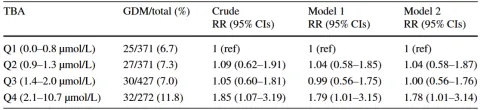
| 32086784 | This study evaluated the longitudinal associations between maternal total bile acid (TBA) levels in early mid-pregnancy and the subsequent risk of gestational diabetes mellitus (GDM). A prospective cohort of 1,441 pregnant women was followed, with TBA levels measured during gestational weeks 14–18 and GDM diagnosed by a 75-g oral glucose tolerance test (OGTT) at 24–28 weeks. The GDM rate was 7.9%, and women with GDM had significantly higher mean TBA levels than those without (2.1 ± 2.0 vs. 1.5 ± 1.0 μmol/L, P = 0.000). After adjusting for confounders, women in the highest TBA quartile (2.1–10.7 μmol/L) had a 1.78-fold increased risk of GDM (95% CI: 1.01–3.14) compared to those in the lowest quartile (0.0–0.8 μmol/L). Elevated TBA levels were associated with increased fasting glucose but not with 1-hour or 2-hour post-OGTT glucose levels. These findings identify TBA as a potential new risk factor for GDM and suggest its involvement in fasting glucose regulation during pregnancy. |
Risk factor |
GDM |
| 28380377 | This study explores the role of bile acids in exacerbating sepsis through the activation of the NLRP3 inflammasome. Bile acids, identified as danger-associated molecular patterns (DAMPs), can trigger both signal 1 and signal 2 of the NLRP3 inflammasome in inflammatory macrophages, leading to a prolonged calcium influx and enhanced inflammasome activation when combined with ATP. Experimental cholestasis was found to sensitize mice to LPS-induced sepsis, while treatment with cholestyramine, a bile acid sequestrant, protected the mice. Additionally, the study highlights the regulatory role of the farnesoid X receptor (FXR), which negatively regulates the NLRP3 inflammasome by physically interacting with NLRP3 and caspase 1. Fxr-null mice were more susceptible to endoxemia shock, whereas FXR-overexpressing mice showed increased resistance to sepsis. These findings suggest that bile acids and FXR are key modulators of sepsis pathogenesis, offering potential therapeutic implications for cholestasis-associated sepsis by targeting FXR | Mechanism | Inflammatory |
RF's name
Total Bile Acid
RF's type
Liver function indicator