
| Literature link | GPT Summary | Evidence category | Disease type |
|---|---|---|---|
| 17237424 | Adipocytokines, predominantly derived from adipocytes, play a crucial role in regulating metabolism and insulin resistance, with some, such as adiponectin and leptin, also influencing immune and inflammatory functions. Visfatin, identified as a new adipocytokine, is known to impact insulin resistance by binding to the insulin receptor. In this study, recombinant visfatin was shown to activate human leukocytes and induce cytokine production, particularly IL-1β, TNF-α, and IL-6 in CD14(+) monocytes. Additionally, visfatin increased the expression of costimulatory molecules (CD54, CD40, and CD80) and enhanced the uptake of FITC-dextran, as well as the ability of monocytes to induce lymphocyte proliferation. The effects of visfatin were found to involve the p38 and MEK1 pathways, with activation of NF-kB observed. In vivo, visfatin increased circulating IL-6 levels in BALB/c mice. Furthermore, elevated visfatin levels and increased mRNA expression were observed in the plasma and colonic tissue of patients with inflammatory bowel diseases (IBD), such as Crohn's disease and ulcerative colitis. Macrophages, dendritic cells, and colonic epithelial cells were identified as potential sources of visfatin. This study suggests that visfatin plays a role as a proinflammatory mediator, contributing to inflammatory conditions such as IBD |
Mechanism |
Inflammatory |
| 17392604 | Pre-B-cell colony-enhancing factor (PBEF), also known as visfatin, is an adipocytokine found in high levels in visceral fat. It exerts insulin-mimetic effects by binding to and activating the insulin receptor, contributing to metabolic processes. PBEF was initially discovered as a cytokine involved in B-cell differentiation and was later recognized for its role in inhibiting neutrophil apoptosis in sepsis. Although PBEF lacks a signal sequence, it is secreted and involved in regulating inflammatory responses. In addition to its role in inflammation, PBEF/visfatin has been implicated in the pathophysiology of labor, colorectal cancer, and cell cycle regulation. Intracellularly, PBEF/visfatin functions as a cytosolic enzyme crucial for nicotinamide adenine dinucleotide (NAD) synthesis, particularly important for vascular smooth muscle cell maturation. This review summarizes the broad functions and pathophysiological implications of PBEF/visfatin, emphasizing its potential involvement in various diseases and its evolutionary conservation across species. |
Mechanism |
Insulin resistance |
| 21325104 | This case-control study aimed to evaluate the potential of maternal serum visfatin and adiponectin concentrations in early pregnancy as biomarkers for predicting gestational diabetes mellitus (GDM). The study included 100 women who developed GDM and 300 nondiabetic controls. Serum concentrations of visfatin and adiponectin were measured between 11 and 13 weeks of gestation. Regression analysis was conducted to identify maternal characteristics affecting these biomarkers. The results showed that compared to the nondiabetic group, women with GDM had significantly higher levels of visfatin (1.34 MoM) and lower levels of adiponectin (0.66 MoM). Screening for GDM by combining maternal factors with these biomarkers resulted in a detection rate of 68% at a false-positive rate of 10%. The study concluded that serum visfatin and adiponectin levels in early pregnancy, when combined with maternal factors, could provide effective early screening for GDM. | Risk factor | GDM |
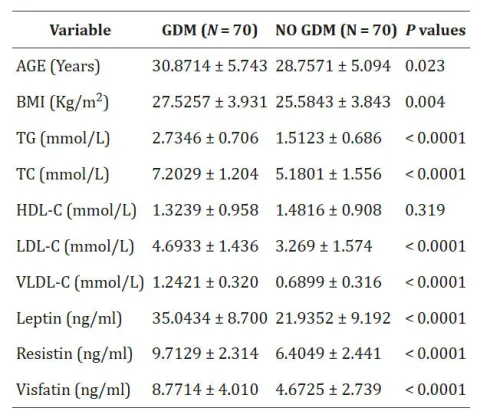
| 31836012 | This case-case control study aimed to determine whether serum leptin, resistin, and visfatin levels in the first trimester are altered in pregnancies that develop gestational diabetes mellitus (GDM) and whether these changes can predict the disease. The study compared the biochemical and anthropometric parameters of 70 pregnant women who later developed GDM with 70 women who did not, at the Volta Regional Hospital in Ghana. The results showed significant differences in leptin, resistin, and visfatin levels, as well as dyslipidemia, between the two groups (p < 0.05). The area under the Receiver Operating Characteristic Curves (AUCs) for leptin, resistin, and visfatin were 0.812, 0.836, and 0.799, respectively. Increased levels of leptin (OR = 1.166), resistin, and visfatin were strongly associated with GDM (all p < 0.0001). The study concluded that elevated levels of leptin, resistin, and visfatin in the first trimester could serve as useful predictive biomarkers for GDM. | Risk factor | GDM |
| KEGG pathway |
|---|
| Insulin resistance |
RF's name
Visfatin
RF's type
Adipocyte factor