
| Literature link | GPT Summary | Evidence category | Disease type |
|---|---|---|---|
| 29157043 | This study aimed to evaluate the association of maternal first-trimester plasma lipid profiles, fasting plasma glucose (FPG), and triglyceride-glucose (TyG) index with the risk of gestational diabetes mellitus (GDM) and large for gestational age (LGA) infants in Iranian mothers. The study followed 954 healthy pregnant women and measured maternal fasting lipids and glucose concentrations at around nine weeks of gestation. The results showed that the incidence of GDM and LGA infants was 18.4% and 26.1%, respectively. There was a significant correlation between increased FPG, triglycerides, TG/HDL-C ratio, and TyG index with the risk of GDM and LGA. After adjusting for potential confounders, women in the top tertile of these markers had significantly higher risks of both GDM and LGA, with relative risks ranging from 3.9 to 5.3 times greater compared to women in the bottom tertile. The TyG index, in particular, was found to be a more robust early predictor of both GDM and LGA infants. | Risk factor | GDM |
| 38616992 | This study aimed to evaluate the potential of early pregnancy triglyceride-glucose (TyG) index, triglyceride to high-density lipoprotein cholesterol ratio (TG/HDL-C), low-density lipoprotein cholesterol to high-density lipoprotein cholesterol ratio (LDL-C/HDL-C), and total cholesterol to high-density lipoprotein cholesterol ratio (TC/HDL-C) in predicting gestational diabetes mellitus (GDM). A total of 1,073 pregnant women were enrolled in the study, with data collected on anthropometric measurements and lipid profiles in the first trimester, followed by a 75g oral glucose tolerance test (OGTT) between 24-28 weeks of gestation. The results showed that women with GDM had higher TyG, TG/HDL-C, and LDL-C/HDL-C levels, while no significant difference was observed in TC/HDL-C. TyG, TG/HDL-C, LDL-C/HDL-C were positively correlated with insulin resistance, as measured by the Homeostatic Model Assessment of Insulin Resistance (HOMA-IR), with TyG emerging as an independent risk factor for HOMA-IR. The TyG index had an area under the curve (AUC) of 0.692, which was comparable to that of HOMA-IR (AUC 0.703). The study also identified the optimal cut-off values for TyG index, TG/HDL-C, and HOMA-IR in predicting GDM as 7.088, 0.831, and 1.8, respectively. HOMA-IR showed the highest sensitivity (79.1%), while TyG index (64.3%) and TG/HDL-C (64.3%) demonstrated better specificity. The study concluded that early pregnancy TyG index and TG/HDL-C are useful in identifying women at risk for GDM, with TyG index being a more effective predictor compared to TG/HDL-C. | Risk factor | GDM |
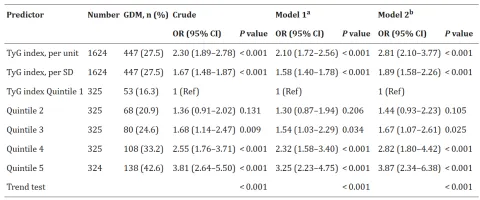
| 38528508 | This prospective cohort study aimed to explore the association between the triglyceride-glucose (TyG) index in early pregnancy and the development of gestational diabetes mellitus (GDM) in the second trimester, as well as its predictive potential for other pregnancy-related complications (PRCs). The study involved 1,624 pregnant women who underwent antenatal counseling and continuous monitoring until delivery. The TyG index was calculated using maternal triglyceride and fasting plasma glucose levels in early pregnancy. Logistic regression analysis showed that for every 1-unit increase in the TyG index, the risk of GDM increased by 2.10-fold, with the highest risk observed in the highest quintile of TyG compared to the lowest (odds ratio: 3.25). The TyG index was found to be a reliable predictor of GDM, with an optimal cutoff value of 8.890 and an area under the curve (AUC) of 0.641. Combining the TyG index with maternal age and pre-pregnancy body mass index improved predictive performance (AUC: 0.672). Additionally, the TyG index was associated with an increased risk of gestational hypertension, but no significant association was found with preeclampsia, placental abruption, intrauterine distress, or premature rupture of membranes. The study concluded that the TyG index could effectively identify women at risk for GDM in the second trimester and suggested its incorporation into routine clinical assessments to enable timely interventions, improving maternal and infant health outcomes. | Risk factor | GDM |
RF's name
Triglyceride-Glucose Index
RF's type
Lipid and glucose metabolism indicator