| Literature link | GPT Summary | Evidence category | Disease type |
|---|---|---|---|
| 29940874 | This large hospital-based retrospective study examined the relationship between early pregnancy hemoglobin (Hb) levels and the risks of gestational diabetes mellitus (GDM), pre-eclampsia (PE), and preterm birth in 21,577 singleton pregnancies. Higher Hb levels in early pregnancy were associated with an increased risk of GDM and PE (OR: 1.27 for Hb 130-149 g/L; OR: 2.06 for Hb ≥ 150 g/L), while lower Hb levels (<110 g/L) were associated with an increased risk of preterm birth. Conversely, high Hb levels were linked to a reduced risk of preterm birth (OR: 1.30 for Hb 130-149 g/L; OR: 2.38 for Hb ≥ 150 g/L). In women with a BMI < 24 kg/m2, high Hb levels predicted higher GDM risk and lower preterm birth risk, whereas in women with a BMI ≥ 24 kg/m2, high Hb levels were associated only with increased GDM risk (OR: 2.33 for Hb > 150 g/L). These findings suggest that early pregnancy Hb levels can serve as a predictive marker for GDM, PE, and preterm birth, with varying effects based on maternal BMI. |
Risk factor |
GDM |
| 35139935 | This study found that higher hemoglobin (Hb) concentrations at the first prenatal visit (<12 weeks) and Hb changes from the first visit to the second trimester were significantly associated with an increased risk of gestational diabetes mellitus (GDM). Women with GDM had higher Hb levels (11.91 g/dL vs. 11.74 g/dL), with adjusted odds ratios of 1.14 and 1.25 for early Hb levels and second-trimester Hb changes, respectively. The associations were more pronounced in women aged 35 years or older, non-Malays, and those who were overweight or obese. These findings suggest that elevated Hb levels and iron status in early pregnancy may be risk factors for GDM, particularly in certain high-risk groups. | Risk factor | GDM |
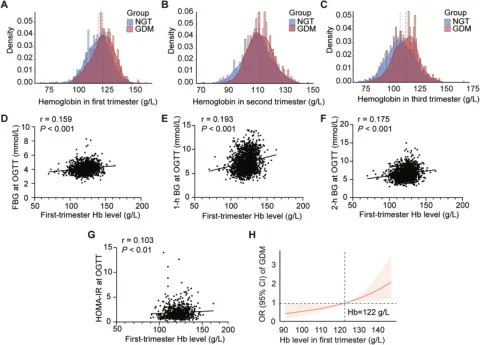
| 38951151 | This study investigated the relationship between first-trimester hemoglobin (Hb) levels, the Haptoglobin (Hp) genotype, and the risk of gestational diabetes mellitus (GDM) in a cohort of 358 women with GDM and 1324 with normal glucose tolerance (NGT). Women who developed GDM had significantly higher Hb levels throughout pregnancy. A first-trimester Hb concentration exceeding 122 g/L was associated with a linear increase in GDM risk, glucose levels, HOMA-IR values, cesarean delivery rates, and adverse neonatal outcomes. Elevated first-trimester Hb was identified as an independent risk factor for GDM, even after adjusting for confounders. The Hp2-2 genotype was more prevalent in GDM cases when Hb levels exceeded 122 g/L, and significant interactions were observed between Hb levels and the Hp genotype for GDM risk. Stratified analysis revealed an incremental increase in GDM risk when both high Hb levels and the Hp2-2 genotype were present. Mediation analysis further showed that first-trimester Hb partially mediated the association between the Hp genotype and GDM. The study concludes that increased first-trimester Hb levels are strongly associated with GDM and adverse outcomes, and this relationship is moderated by the Hp2-2 genotype, highlighting the potential for integrating Hb levels and Hp genotype into GDM risk prediction. |
Risk factor | GDM |
| 35102239 | This study found that higher first-trimester maternal hemoglobin (Hb) levels are independently associated with an increased risk of gestational diabetes mellitus (GDM) after adjusting for key covariates. Hb levels were also positively correlated with pre-pregnancy BMI, glucose levels, and blood pressure. While elevated Hb levels predicted GDM risk, they had minimal impact on perinatal outcomes. | Risk factor | GDM |
RF's name
Hemoglobin A1c
RF's type
Complete blood count