
| Literature link | GPT Summary | Evidence category | Disease type |
|---|---|---|---|
| 20357764 | Adiponectin is an anti-diabetic adipokine whose receptors possess a unique seven-transmembrane topology distinct from G-protein-coupled receptors. This study demonstrates that adiponectin activates adiponectin receptor 1 (AdipoR1) to induce extracellular Ca2? influx, which is essential for subsequent activation of Ca2?/calmodulin-dependent protein kinase kinase beta (CaMKKβ), AMP-activated protein kinase (AMPK), and SIRT1. This signaling cascade increases the expression and deacetylation of peroxisome proliferator-activated receptor gamma coactivator-1α (PGC-1α), thereby enhancing mitochondrial biogenesis in myocytes. Muscle-specific disruption of AdipoR1 abolishes adiponectin-induced Ca2? influx, suppresses CaMKK, AMPK, and SIRT1 activation, and reduces PGC-1α expression and mitochondrial content. This impairment leads to decreased oxidative type I muscle fibers, diminished oxidative stress detoxification, insulin resistance, and reduced exercise endurance. The findings suggest that decreased adiponectin and AdipoR1 levels in obesity may contribute to mitochondrial dysfunction and insulin resistance in diabetes, highlighting AdipoR1 as a potential therapeutic target for metabolic disorders. |
Mechanism |
Insulin resistance |
| 21186369 | Adiponectin, an adipocyte-derived secretory factor, enhances insulin sensitivity, reduces inflammation, and promotes cell survival, yet the underlying mechanism remains unclear. This study identifies a critical role of adiponectin in stimulating ceramidase activity through its receptors, AdipoR1 and AdipoR2, leading to increased ceramide catabolism and the production of the anti-apoptotic metabolite sphingosine-1-phosphate (S1P), independent of AMP-activated protein kinase (AMPK). Using apoptosis models in pancreatic beta cells and cardiomyocytes, the findings show that adiponectin overexpression reduces caspase-8-mediated apoptosis, while adiponectin deficiency exacerbates cell death via sphingolipid-mediated mechanisms. Cells lacking both adiponectin receptors exhibit impaired ceramidase activity, elevated ceramide levels, and increased susceptibility to palmitate-induced apoptosis. These findings suggest that adiponectin’s systemic benefits are mediated through sphingolipid metabolism, providing a unifying mechanism for its protective effects in metabolic and cardiovascular health. |
Mechanism |
Insulin resistance |
| 29937410 | Adiponectin, a key adipokine with metabolic and anti-inflammatory properties, plays a crucial role in multiple organs, including the cardiovascular system, muscle, liver, adipose tissue, brain, and bone. Recent studies have explored adiponectin signaling in bone metabolism, but human association studies and mouse models have yet to establish a clear cause-and-effect relationship. This complexity may stem from the different multimeric forms of adiponectin, which exhibit variable receptor binding (AdipoR1 and AdipoR2) depending on cell-specific receptor variants in bone. The discovery of small-molecule AdipoR1 agonists suggests a potential regulatory role of this receptor in bone metabolism. AdipoR1 activation in osteoblasts promotes oxidative phosphorylation, enhancing differentiation likely via suppression of the Wnt inhibitor sclerostin. Additionally, adiponectin’s anti-inflammatory signaling reduces the RANKL-to-OPG ratio in osteoblasts, thereby inhibiting osteoclastogenesis. This review evaluates the role of adiponectin signaling in skeletal homeostasis and explores the therapeutic potential of AdipoR1 as a target for metabolic bone disorders. |
Mechanism |
Metabolic bone |
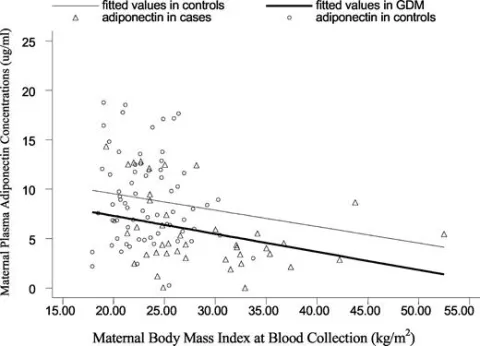
| 15126557 | This study found that low maternal plasma adiponectin levels are significantly associated with an increased risk of gestational diabetes mellitus (GDM). In a nested case-control study of 41 GDM cases and 70 controls, women with GDM had significantly lower adiponectin concentrations (4.4 vs. 8.1 μg/mL, *P* < 0.001). Adiponectin levels below 6.4 μg/mL were observed in 73% of GDM cases versus 33% of controls. After adjusting for confounding factors, women with low adiponectin had a 4.6-fold increased risk of GDM (95% CI: 1.8-11.6). These findings, consistent with associations seen in type 2 diabetes, suggest that hypoadiponectinemia is a strong predictor of GDM and highlight the need for further research on interventions to modulate adiponectin levels. | Risk factor |
GDM |
| 32747382 | This study investigated the association of multiple adipokines with gestational diabetes mellitus (GDM) risk in the NICHD Fetal Growth Studies cohort. Longitudinal analysis showed significant differences in chemerin, soluble leptin receptor (sOB-R), adiponectin, and high-molecular-weight adiponectin (HMW-adiponectin) between GDM cases and controls from early to mid-pregnancy. Higher levels of FABP4, chemerin, IL-6, and leptin were positively associated with increased GDM risk, while adiponectin and sOB-R were inversely associated with GDM. At 10-14 weeks, including FABP4, chemerin, sOB-R, and HMW-adiponectin alongside conventional risk factors improved GDM prediction accuracy (AUC 0.77). These findings highlight the potential role of specific adipokines in GDM pathogenesis and their predictive value well before routine screening. | Risk factor | GDM |
| 35444544 | This study investigates the role of Adiponectin Receptor 1 (AdipoR1) in restoring nitric oxide (NO)-mediated flow-induced dilation (FID) in arterioles from patients with coronary artery disease (CAD). The authors hypothesize that AdipoR1 activation is key to this effect and that osmotin, a plant-derived protein, could mimic adiponectin's action. Human arterioles from CAD patients were tested, and it was found that exogenous adiponectin failed to restore NO-mediated FID in arterioles treated with AdipoR1 siRNA. However, osmotin treatment partially restored NO-mediated FID, an effect that was blocked when AdipoR1 expression was reduced. These findings underscore the essential role of AdipoR1 in adiponectin-induced NO signaling and suggest that osmotin may be a potential therapeutic approach for alleviating microvascular endothelial dysfunction in cardiovascular disease patients. | Mechanism | Cardiovascular disease |
RF's name
Adiponectin
RF's type
Adipocyte factor